Tuesday, January 7, 2014

Just One More Reason To Love Citrus

The rebuild has turned a corner, and now instead of taking things out, I’m putting things back in. One pleasant surprise was that when I took apart the planetary gearset (here’s a video of what it looks like and how it works), it was in great shape. Nothing was broken or really even damaged or worn out at all. The clutches, pump, and torque converter took the hit and spared the actual gears that drive the output shaft. So yay for that.

The gears are back in the case, along with the clutches, bands, and various smaller parts. The clutch bands have to be adjusted just so, and for that I’ve got a torque wrench, so hopefully I can get it exactly right.

You remember that at the start, the transmission looked like it had spent time in the Bog of Eternal Stench. It’s still got some dirty corners on the outside, but it’s come a long way. In fact, most of the work of the rebuild was cleaning, and cleaning, and more cleaning. I’ve been using a solution of this solvent in this bin:

washing off the transmission-to-transfer case adapter housing

...the bin having been generously lent/donated to the project by Lydia, the Right Honourable Executive Controller of Household Storage Containers, Defender of the Faith, Destroyer of Tyranny, Taker of Photos, etc, etc.

The solvent is plant-based rather than petroleum-based, which makes it a little more user-friendly, and makes it a little less likely that I’ll be arrested by the EPA/NSA/Google for dumping the used-up solution on the rocks (elsewhere known as “the lawn”).

Almost everything has been cleaned, including the pan, which has made quite a dramatic transformation from this…


To this:


As soon as the torque converter and pump arrive, it will be time to wrap things up and call it good. I’m glad to have this particular adventure (mostly) behind me. Then we’ll go to the next link in the chain, the transfer case. It’s been sitting quietly underneath the table this whole time, behaving itself and trying to look inconspicuous, but it has at least one significant problem: it won’t switch between 2-wheel and 4-wheel drive.

It’s stuck on 2WD, which is what I’ll be using 99% of the time, since I live in a very flat, low-elevation desert, but it still shouldn’t be stuck, and that may indicate other issues. We shall see.

Saturday, January 4, 2014

New Year, New Parts

Before we start, this is the stuff the Eagle's nightmares are made of: http://www.thetruthaboutcars.com/2011/05/junkyard-find-1984-amc-eagle/

So anyway, the scariest part of the rebuild is over. I’m speaking, of course, about the valve body. This is the hunk of metal in the bottom of the transmission that has a bunch of holes and channels milled into it. The holes are home to valves and springs and such (first photo), that together with the channels, direct transmission fluid under high pressure to do its various jobs such as actuating clutch bands and so forth.

one of the many pics I took to document how the various things were supposed to go back in
If it sounds complicated, it is. It’s also extremely exacting. One false move and the whole thing can be ruined. Also, cleanliness is paramount. Seeing as how my workstation is outside, I had to be vigilant about particles of any kind getting into the works while it was all open to the elements. Luckily I was able to do most of it in one day, so the chance of making a serious mistake was reduced.


Here’s the completed valve body, shoehorned into a gallon-size bag, to keep out the dust of the urban desert, as well as any moisture, during the wait to return to its home. We don’t get much dew around here, but you can’t be too careful with this stuff.


The front and rear clutches are also completed. This rather dry but short and informative video shows part of that process. Inside the clutch pack is a stack of alternating friction discs and steel plates. Most of the old friction discs in both clutches were worn almost completely clean of friction material (see old vs. new below).

new one is on the right, obviously

new/old frictions and steels. you can't see it, but the friction disc on the bottom right is actually concave from being warped by heat
this is the inside of the rear clutch, freshly cleaned and reassembled with new rubber seals, friction discs and steel plates
The condition of the clutches would probably have led to erratically-timed and sometimes nonexistent shifts toward the end. Some of the steels were also warped and scorched with rainbow-looking patterns on them. Some really brutal heat was going on in there. I’m considering adding an auxiliary transmission cooler later on, but we’ll see. Whatever else can be said, this transmission gave all it had, and died with its boots on, a faithful soldier till the end. Of course, to paraphrase Gen. MacArthur, old transmissions never die, they just get rebuilt.

Thursday, December 26, 2013

Some 'Splainin'

An oldie, but a goodie
Indeed, the rebuild has begun. The case has been mostly emptied, and soon it will be time to start the tedious process of taking apart, cleaning, and putting back together every section you see out on the table down below. After my glorious Festivus victory at Ye Olde Battle of Torque Converter, everything came out pretty much like the book said it would, so that was a relief. Some things were reluctant to move, since bolt threads can get pretty set in their ways after a few decades, but a little WD-40, as usual, provided the necessary persuasion.
this is a weird, bird's eye, wide-angle shot, but you get the idea.


This is the first time the transmission has been opened up since it failed, and I’m pleased to be able to provide a definitive diagnosis, as follows, for all the symptoms that have been observed, both by Worth and myself. 


The transmission started out its failure with a screeching sound when in operation, which turned out to be its death throes. It then failed entirely, and did not respond at all when the shifter was moved into gear – it was like the transmission and wheels were unaware of the presence of the running engine.


Oddly enough, I had a dream, before I even got the transmission out, that the problem was in the torque converter, and that a new one would cost $91. Why? Who knows. But, strange to tell, that’s almost exactly what a replacement will cost, and even if I hadn’t chosen to cut it apart, it would have needed replacement anyway. Alert readers will remember my long struggle to remove the converter, which was royally stuck in place. The root issue was as described by a user in yet another forum I visited…

“…it looks like they overheated the Torque Converter. What happened then is that the fluid in the converter became really hot and caused the inner pump gear to grow and seize. The converter hub is either distorted and wrapped around the step on the ground sleeve and/or is distorted enough that it won't pull out through the bushing. It will take 2000-4000 lbs to pull it out. You'll need a really solid bar and some jack screws. The pump, torque converter, and most likely the ground sleeve are ruined.”

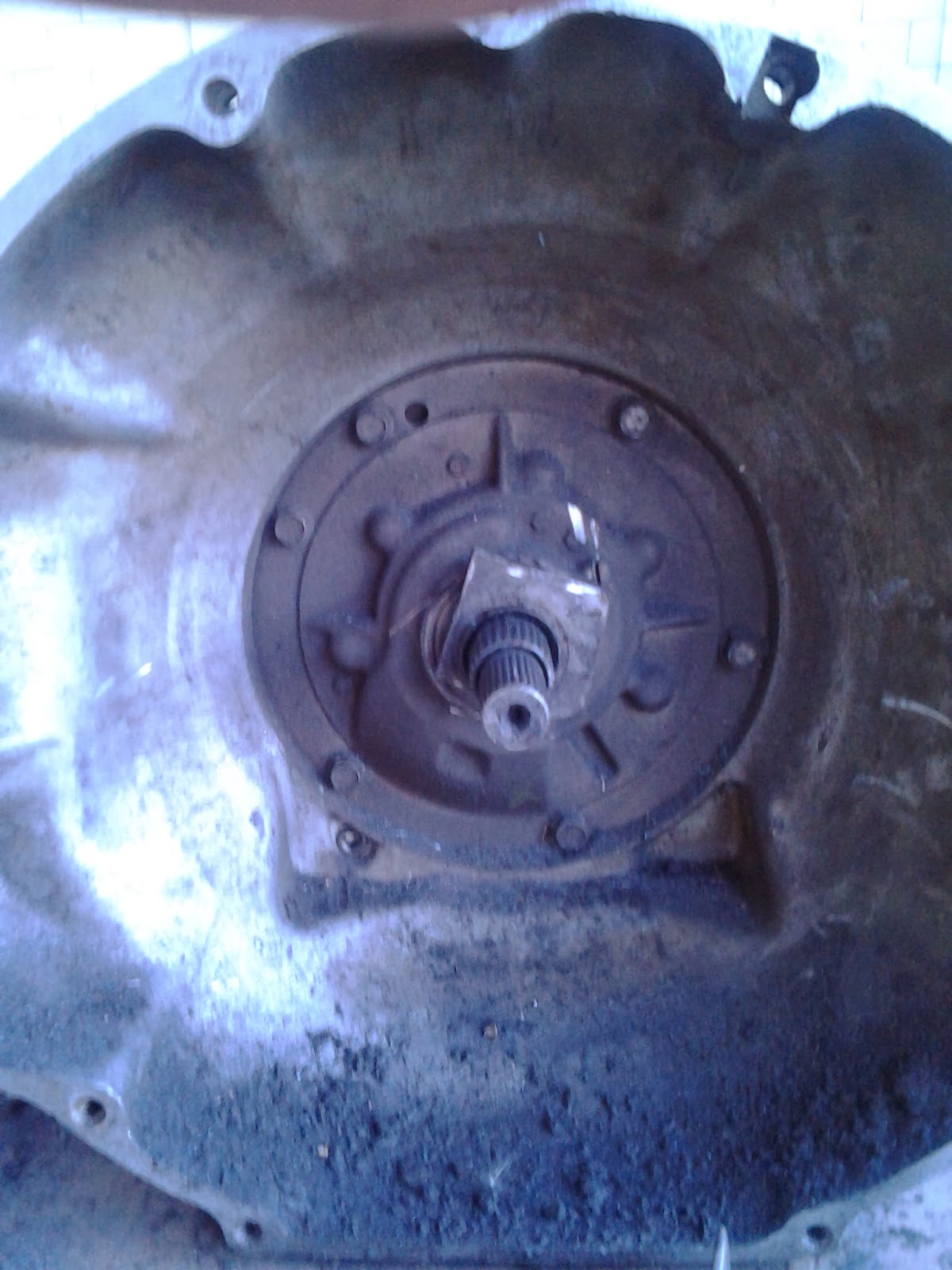
Once I got the torque converter and pump out, I could see that the hub on the end of the torque converter that connects to the pump just behind it, had indeed warped. It got deformed so badly that two large pieces broke off of it (photo 1 below), and the rest curled back and hooked around the bushing (photo 2 below), making the torque converter impossible to remove. 

that piece of metal in my hand, and another like it, used to help drive the pump, and likely snapped off when the pump gear overheated and seized.

slightly below center, the warped and jagged thing around the shaft
The torque converter could still spin freely with the engine, but the pump - the transmission’s heart - was now not being turned. This means that there was no fluid pressure or circulation, which I observed in another entry a while back. When these things are lacking, then you are having a bad problem and you will not go to space today.


Symptoms: screeching, then an eerie silence and immobility.

Diagnosis: no transmission fluid pressure, due to a terminal overheating failure of the pump gear and converter hub, which in turn was likely due to a fluid leak.

Treatment: new torque converter and pump, as part of a complete rebuild.

Wednesday, December 25, 2013

The Obligatory Christmas Post

On the twelfth day of Christmas, the Eagle gave to me:

12 pushrods pushing...


11 tiny rust spots...


10-inch wide rims (well, almost)...


9 starter gear teeth...


8 steel clutch plates...


7 ignition wires...


6 pistons pumping...


FIVE! SEAT! BELTS!


Four-wheel drive...


Three ash trays...


Two different keys...

And a sketchy OEM bumper jack.


Monday, December 23, 2013

It's a Festivus miracle!

So I procured an angle grinder and some metal cut-off wheels and went at it with all I had. There we were... me and the transmission... locked in mortal combat. The air filled with millions of sparks, which - fun fact - are actually little white-hot bits of metal, and when they land all over your arms because you're wearing short sleeves in December (because Arizona), you end up with countless tiny burns all over. So now you know.

That Swedish guy found that his torque converter was stuck because of some bearing or something down in the center of it. I finally got into the middle of it, aaaaanddddd.... still stuck:


Advantage: transmission. So whatever was stuck was way in the back. 

It was getting dark, so I had to put down my weapon for the weekend. But with renewed strength, I courageously returned to the field of battle today after work, and finally, what should have been the easiest part of this project was done.

As Rigby would say, check out THIS!


Yeah, there's a little square of steel around the input shaft still, but that appears to be part of something that goes back into the pump, so it shouldn't be a problem at this point, since the pump needs to come out and be replaced also.

Off to the side, the dragon lay slain in pieces on yonder back patio, forsooth. The deed is done, and the peasant village is saved.


That dusty sludge is transmission fluid dragon's blood mixed with steel dust and probably disintegrated bits of several cutting wheels. Tomorrow, the rebuild starts.

Friday, December 20, 2013

Man vs. Machine

There’s an old saying that goes, “when all you have is a power drill, everything looks like a torque converter.”

No, that’s not quite right… is it? Oh well, close enough. The sparseness of recent updates is due to one thing. When I got the transmission out of the Eagle, I was expecting to have to be extra careful with the torque converter, to make sure it didn’t accidentally slide off of the input shaft and hit something, like a vital organ or foot or whatever. This is a common enough concern in “the biz” that some wholesale parts suppliers actually sell little metal brackets to hold the thing in place while the transmission is being removed.

Source: brocksupply.com. Full disclosure: I currently work for these people.

It was ironic, therefore, when I went to remove said torque converter, and it came out about 1 cm before saying “clunk” and stopping. It was stuck. I pulled harder. Stuck. I rotated and tugged and wiggled it, but no dice. Tried to pry it out with a crowbar. Didn’t budge. Took a cue from an online forum and brought over a large friend with a second crowbar. Nothing. The same large friend put a strap behind the converter and pulled hard enough to lift the 115-lb transmission into the air several times. Haha, nope!

At this point I got a little desperate. Maybe I’ll just drill the thing to pieces to remove it. I was planning on replacing the 30-year-old non-repairable part anyway. So I got out my drill and biggest drill bit, picked a spot, and went for it. It took a long time to get through what appears to be about ¼” of solid steel. So long, in fact, that I abandoned this line of attack and tried to drill some holes right near the input shaft, to see if I could unstick what was stuck. Long story short, I blunted several drill bits, got iron filings everywhere, and ruined 2 chisels in the process, and the torque converter still won. The transmission’s been out for almost three weeks, and all I’ve done is clean it.

Just... pathetic, really.
Defeated, I went back to the forums. After a diligent search, I literally found some Swedish guy whose stuck torque converter experience matched mine to a T, right down to the amount of movement that it had on the shaft. His solution was not fundamentally different from mine, but was far better executed. He cut the torque converter to pieces with an angle grinder, and even had pictures showing the (successful) process.

I’m pretty sure that stuff like this was what we were all so excited about in the 90’s with this new internet thing (remember the “Do you… Yahoo?” commercial where the old fisherman uses the internet to find a better fishing bait?). I took a short break from taking the “information superhighway” for granted, that day. Also, it’s a good thing Scandinavians learn English.

New post to come, once I’ve secured an angle grinder.

Saturday, December 7, 2013